Tuesday, May 15, 2012

The Spectre of a Rose

It's a rainy Tuesday here in upper Manhattan as Yours Truly awakes from his dogmatic slumbers to put fingers to keyboard once again. As usual, there's a lot of bile and only a smidgeon of edification waiting to burst into digital obscurity. But first . . .


May 15, 1993, was a Saturday—a warm, sunny, mid-spring Saturday, a perfect day for a wedding. A bald, bearded, and very anxious man in his mid-forties, neither affluent nor prepossessing, dressed for the first time in his life in a morning coat, stood before the altar of a Brooklyn church. Next to him stood a young woman in a white wedding dress that had been her mother's. After exchanging vows and rings—hers had been his mother's—kneeling for blessings and for the Blessed Sacrament, the two of them turned and walked up the aisle hand in hand, into a modest but loving reception and then into a future that turned out to be very different from the one he, at least, had been able to imagine

But for that man, at least, now balder, still bearded and anxious, less prepossessing and even further from affluent, that day and all that followed from it—five children, days and nights of laughter and of tears, of caresses and of coldness, of fleeting dreams and persistent nightmares—has shown him the richness of the house of God.

And for the woman, who has borne the consequences of his fecklessness and bad judgments, saddled with making up for his shortcomings as a husband and a father, how does she remember that nineteen-years-ago day?

The devotees of Madame Blavatsky sought to evoke the spectre of a rose from its ashes. I am no magician; I can only pray that even now, somewhere there is a bud that, with time and nourishment and love, can burst into blossom again.

Happy anniversary, Julia.


Tuesday, January 31, 2012

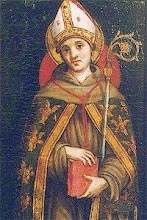
Saint of the Day: John Bosco, Priest

I guess this is really the Saint of the Afternoon or Evening. Sorry.

Today the Roman calendar commemorates St. John Bosco, founder of the Salesian order, whose apostolate was the care and education of boys who were orphaned, abandoned, or trapped in poverty.
He was born in 1815 and died on this date in 1888. His ministry, like that of the Protestant George Mueller (see here) was marked by miracles of provision, and his dreams were believed by many to be prophetic. A life of St. John Bosco may be found here.


 From the Roman Missal, 3rd edition

O God, who raised up the Priest Saint John Bosco
as a father and teacher of the young,
grant, we pray,
that, aflame with the same fire of love,
we may seek out souls and serve you alone.
Through our Lord Jesus Christ, your Son,
who lives and reigns with you in the unity of the Holy Spirit,
one God, for ever and ever.

Monday, January 30, 2012

Saint of the Day, Ecumenical Edition: Charles I, King and Martyr

Today marks the 363rd anniversary of the beheading of King Charles I (1600–1649). In my Anglican days, I formed a great devotion to the Royal Martyr. I remember vividly attending a showing of the film Cromwell in a Times Square theater with a group of friends, booing the title character and applauding when the King, played by the incomparable Alec Guinness, made an appearance. That devotion has continued, though more informally, since I returned to Catholic unity. It is only to be hoped that this devotion will be permitted to the Anglican ordinariates established by the Holy Father. In honor of the day, I offer a florilegium to his memory.


It is all I have now left me, a power to forgive those that have deprived me of all; and thank God have a heart to do it, and joy as much in this grace, which God hath given me, as in all my former enjoyments; for this is a greater argument of God’s love to me than any prosperity can be. Be confident (as I am) that the most of all sides, who have done amiss, have done so, not out of malice, but misinformation, or misapprehension of things.
. . .
Farewell, till we meet, if not on earth, yet in Heaven.
—From the last letter of King Charles to his son


  He nothing common did or mean
Upon that memorable scene;
      But with his keener eye
      The axe’s edge did try:
Nor called the gods, with vulgar spite,
To vindicate his helpless right;
      But bowed his comely head
      Down, as upon a bed.
                                     —Andrew Marvell


 O Lord, we offer unto thee all praise and thanks for the glory of Thy grace that shined forth in thine anointed servant Charles; and we beseech Thee to give us all grace, by a careful studious imitation of this Thy blessed Saint and Martyr, that we may be made worthy to receive benefit by his prayers, which he, in communion with the Church Catholic, offers up unto Thee, through Thy Son, our Blessed Saviour Jesus Christ.
                            —Brian Duppa, Bishop of Salisbury and Winchester

Saturday, January 28, 2012

Saint of the Day: Thomas Aquinas, Priest and Doctor

I had the good fortune during my college days to have been taught logic, anthropology, and metaphysics (in a public university) by a genuine Thomist—an old-fashioned, twenty-four-Thomistic-theses Thomist.  If, over the years, I have strayed from the Thomist path in this or that particular, my love of the Angelic Doctor (the Common Doctor of the church) remains. If I have chosen his fellow-mendicant as my alter ego, it is more because of what moves my heart than what moves my mind.

Indeed, it's the mystic Thomas, the Thomas of the Corpus Christi liturgy, the Thomas who put down his pen before finishing his second Summa to whom I am most attracted.


In his general audience talk on June 2, 2010, Pope Benedict XVI said:
The last months of Thomas' earthly life remain surrounded by a particular, I would say, mysterious atmosphere. In December 1273, he summoned his friend and secretary Reginald to inform him of his decision to discontinue all work because he had realized, during the celebration of Mass subsequent to a supernatural revelation, that everything he had written until then "was worthless". This is a mysterious episode that helps us to understand not only Thomas' personal humility, but also the fact that, however lofty and pure it may be, all we manage to think and say about the faith is infinitely exceeded by God's greatness and beauty which will be fully revealed to us in Heaven.

From the second lesson at the Office of Readings for today, a conference by St. Thomas:
Why did the Son of God have to suffer for us? There was a great need, and it can be considered in a twofold way: in the first place, as a remedy for sin, and secondly, as an example of how to act.
It is a remedy, for, in the face of all the evils which we incur on account of our sins, we have found relief through the passion of Christ. Yet, it is no less an example, for the passion of Christ completely suffices to fashion our lives. Whoever wishes to live perfectly should do nothing but disdain what Christ disdained on the cross and desire what he desired, for the cross exemplifies every virtue.
 From the Roman Missal, 3rd edition:
 O God, who made Saint Thomas Aquinas
outstanding in his zeal for holiness
and his study of sacred doctrine,
grant us, we pray,
that we may understand what he taught
and imitate what he accomplished.
Through our Lord Jesus Christ, your Son,
who lives and reigns with you in the unity of the Holy Spirit,
one God, for ever and ever.


Friday, January 27, 2012

Saint of the Day: Angela Merici, Virgin


St. Angela's birth date is traditionally given as March 21, 1474. Today is the anniversary of her death in 1540. She is remembered mostly as the founder of the Ursulines, the first order of religious women devoted to teaching. Her body, clothed in the habit of the Third Order of St. Francis, reposed in the Church of St. Afra in Brescia, which was completely destroyed by Allied bombing during the Second World War. The statue pictured above is in St. Peter's Basilica in Rome.

From the Roman Missal, 3rd edition:
May the Virgin Saint Angela never fail to commend us
to your compassion, O Lord, we pray,
that, following the lessons of her charity and prudence,
we may hold fast to your teaching
and express it in what we do.
Through our Lord Jesus Christ, your Son,
who lives and reigns with you in the unity of the Holy Spirit,
one God, for ever and ever.

Thursday, January 26, 2012

Saints of the Day—Timothy and Titus

All most of us (me, certainly) know about Sts. Timothy and Titus is that they were disciples of St. Paul and the addressees of three letters, two to Timothy and one to Titus. These Pastoral Epistles, as they are called, witness to the development of the church and its ministries. I'm afraid I can't say anything very profound about them, though First Timothy 2:4 does tell us that God "desires all men to be saved and to come to the knowledge of the truth." I take comfort in that when the specters of hyper-Augustinianism and Calvinism flit around my brain. (I do read a fair number of Reformed blogs.)


From the Roman Missal, 3rd edition:
O God, who adorned Saints Timothy and Titus
with apostolic virtues,
grant, through the intercession of them both,
that, living justly and devoutly in this present age,
we may merit to reach our heavenly homeland.
Through our Lord Jesus Christ, your Son,
who lives and reigns with you in the unity of the Holy Spirit,
one God, for ever and ever.


Wednesday, January 25, 2012

Feast of the Day—The Conversion of St. Paul the Apostle

What can I say about St. Paul? In the bookcase on my left as I write this are more than a dozen books devoted exclusively to the Apostle to the Gentiles, and that's probably only a tenth of a tenth of a tenth of a tithe of of the books that have been written about him (the WorldCat lists 14,124). He's one of my principal patrons (Paul is my middle name), and as a convert myself, I'm particularly drawn to this feast.

My conversion was nothing like St. Paul's: no horse, no vision, no monitory blindness, no sudden 180-degree change; Forty-two years out of the font, it seems like I'm not very far down the road, and sometimes I'm not too sure in what direction I'm walking.

The second lesson for the Office of Readings (what used to be Matins) for today is from a sermon by St. John Chrysostom. Here is an excerpt:
The most important thing of all to him, however, was that he knew himself to be loved by Christ. Enjoying this love, he considered himself happier than anyone else; friend of principalities and powers. He preferred to be thus loved and be the least of all, or even to be among the damned, than to be without that love and be among the great and honored.
To be separated from that love was, in his eyes, the greatest and most extraordinary of torments; the pain of that loss would alone have been hell, and endless, unbearable torture.
I'm still trying to learn how to love Christ, and I'm still trying to know, in my heart as well as my head, that he loves me.

From the Roman Missal, 3rd edtion:
O God, who taught the whole world
through the preaching of the blessed Apostle Paul,
draw us, we pray, nearer to you
through the example of him whose conversion we celebrate today,
and so make us witnesses to your truth in the world.
Through our Lord Jesus Christ, your Son,
who lives and reigns with you in the unity of the Holy Spirit,
one God, for ever and ever.